

When you book a New Patient Assessment at Coastal Podiatry, you’re not simply booking treatment for a painful foot or troublesome toenail. You’re booking a foot health assessment carried out by an experienced podiatrist, designed to identify both current problems and potential issues that may affect your feet in the future.
Many people visit us because they have a specific concern. It may be an ingrowing toenail, thickened nails, corns, callus, verrucae or cracked heels. Others come with foot pain caused by bunions, plantar fasciitis, Morton’s neuroma, Achilles tendon problems, arthritis, flat feet or high arches. We also regularly help patients with fungal nail infections, athlete’s foot and diabetic foot care.
Although your reason for attending may be very specific, our assessment looks at the bigger picture. Healthy feet rely on good circulation, healthy nerves, sound joint function and healthy skin. By assessing each of these areas, we can provide the most appropriate advice and treatment for you. If we spot anything we are less happy about, we always refer onto a specialist or consultant who is an expert in that area. For example, if you have a clear achilles tendon problem, we would discuss sending you for Ultra Sound assessment with an Orthopaedic Consultant.
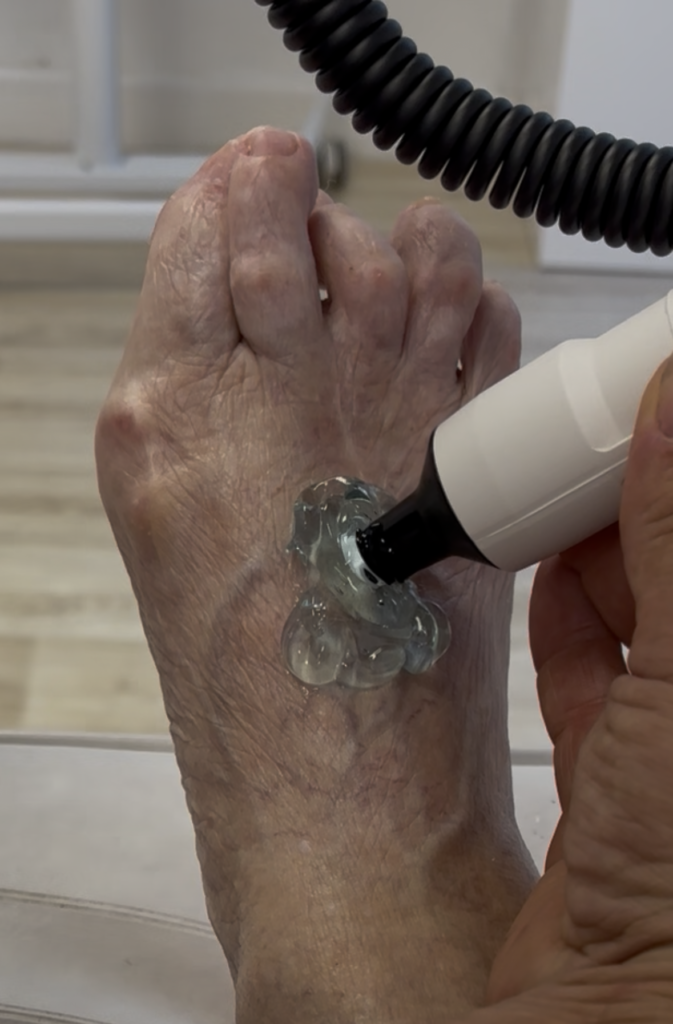
IMAGE: Doppler in use assessing dorsalis pedis pulse
One of the tools we commonly use is a handheld Doppler ultrasound. This allows us to assess the blood flow in the arteries of your feet and lower legs. Podiatrists commonly assess the dorsalis pedis pulse and posterior tibial pulse of the foot.
Rather than simply feeling for a pulse, the Doppler enables us to listen to the quality of blood flow and assess the waveform. A healthy triphasic waveform is generally reassuring, while biphasic waveforms may occur naturally with age. If we identify a monophasic waveform or have any concerns about your circulation, we can recommend appropriate monitoring or, where necessary, refer you for further vascular assessment.
Early identification of circulatory problems can be particularly important for people living with diabetes or those with other vascular risk factors.
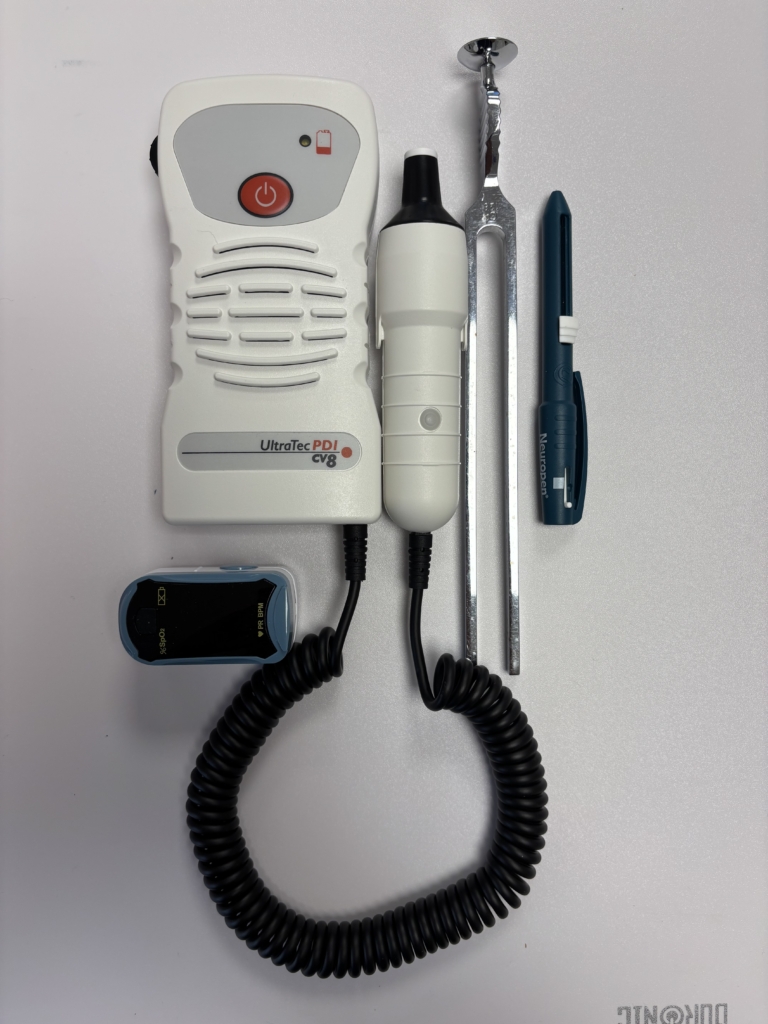
Podiatrist Assessment tool kit. Left to Right. Doppler, Tunning Fork, Neuropen, Oxymeter
The 10-gram monofilament (Green Neuropen) is a simple but extremely important screening tool. It helps us determine whether you can detect light pressure on different areas of your feet.
Reduced protective sensation can increase the risk of unnoticed injuries, particularly in people with diabetes or peripheral neuropathy. If reduced sensation is detected, we can provide education, monitoring and practical advice to help protect your feet and reduce the risk of complications.
We also assess vibration perception using a tuning fork. This measures another aspect of nerve function and complements the monofilament assessment.
Healthy sensation helps you detect pressure, friction and rubbing from footwear before damage occurs. Changes in vibration perception may indicate early nerve changes, allowing us to recommend regular reviews and preventative foot care where appropriate.
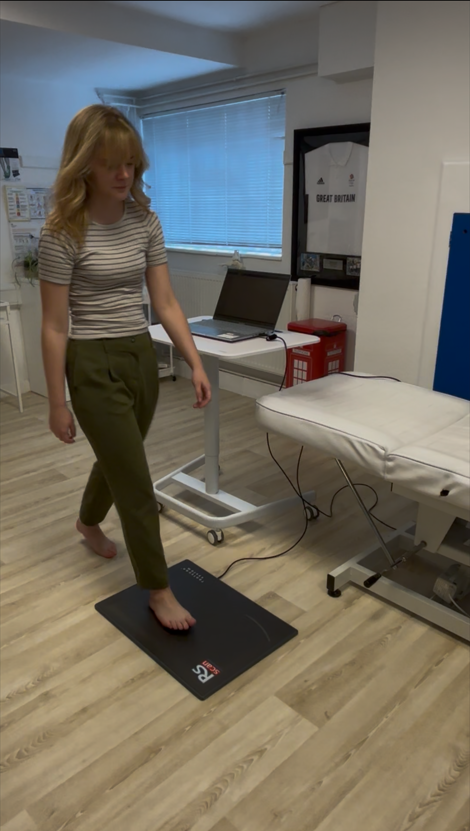
Image – Demonstrating walking over force plate
One of our newest additions is our force plate with the latest RS SCAN FOOTSCAN 9 software for GaitScan pressure analysis system.
This technology measures how pressure is distributed beneath your feet while standing and walking. It highlights areas of increased loading that may not be obvious during a visual examination.
Pressure analysis is particularly valuable for patients with diabetes, where areas of excessive pressure can increase the risk of skin breakdown and ulceration. It is also helpful when assessing foot pain, sports injuries, abnormal walking patterns and when prescribing custom orthoses.
By understanding how your feet function, we can develop treatment plans that are tailored specifically to you.
Although not essential, footscan measurement systems provide valuable data and information as part of the patient journey. The beauty however of the gait scan system is that it is portable and we can take it to health clubs, gyms, physiotherapy centres and more.
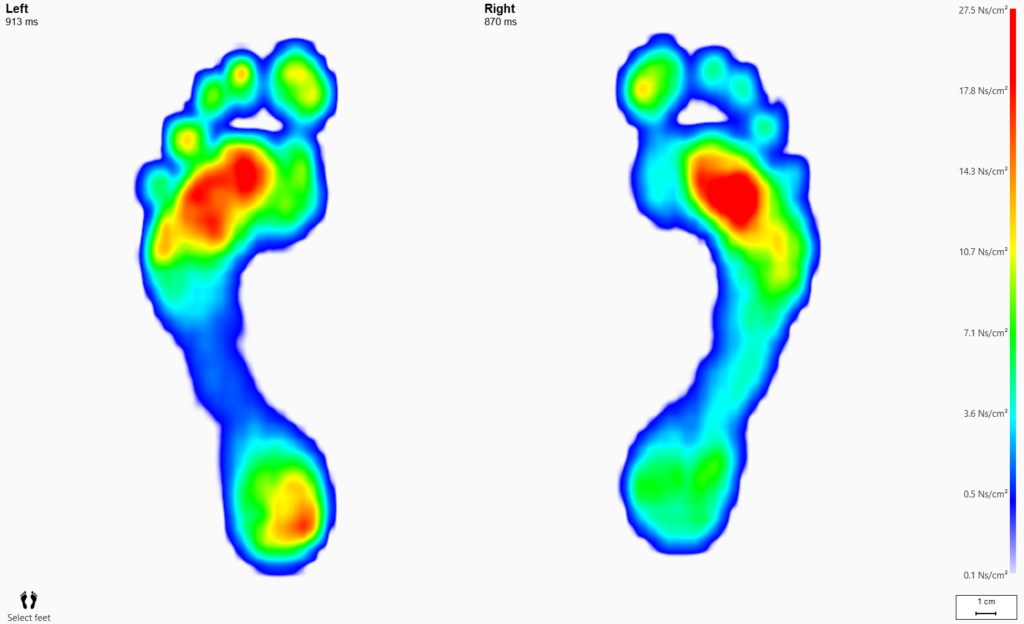
Image shows visual pressure distribution across foot. Red regions are higher pressure, green-blue show lower pressure.
Technology plays an important role, but it never replaces a thorough clinical examination.
Every new patient assessment includes an examination of your foot structure, joint movement and biomechanics, together with a detailed assessment of your skin and nails.
As the skin is your body’s largest organ and your feet are subjected to considerable daily stress, identifying changes early can often prevent more significant problems from developing.
One advantage of our assessment equipment is that it is lightweight and portable.
Whether we are visiting patients in their own homes, residential care homes or hospital settings, we can carry out the same high standard of assessment away from the clinic. This allows patients with reduced mobility to receive comprehensive podiatry care without compromising on quality.
At Coastal Podiatry, we continually invest in modern assessment technology because we believe early diagnosis leads to better outcomes.
While experience and clinical judgement remain at the heart of everything we do, these assessment tools provide valuable information that helps us understand your foot health more completely and recommend the most appropriate treatment for your individual needs.
If you would like to know more about your own foot health, or would like a comprehensive New Patient Assessment, we’d be delighted to welcome you to Coastal Podiatry.
07748 142169
01202 748 899 Sandbanks Clinic
info@coastalpodiatry.co.uk
For further reading on all things feet we recommend you look at the ROYAL COLLEGE OF PODIATRY WEBSITE: